Transformative Learning within a Technology (Mediated Environment) – Post #2
Transformative learning is an educational approach that encourages learners to critically examine their beliefs, assumptions, and experiences in order to develop new perspectives. According to Mezirow (1991), learning becomes transformative when individuals reflect on their existing views and engage in discussions that challenge their way of thinking. Rather than simply acquiring knowledge, learners actively construct meaning and apply their new understanding to future situations.
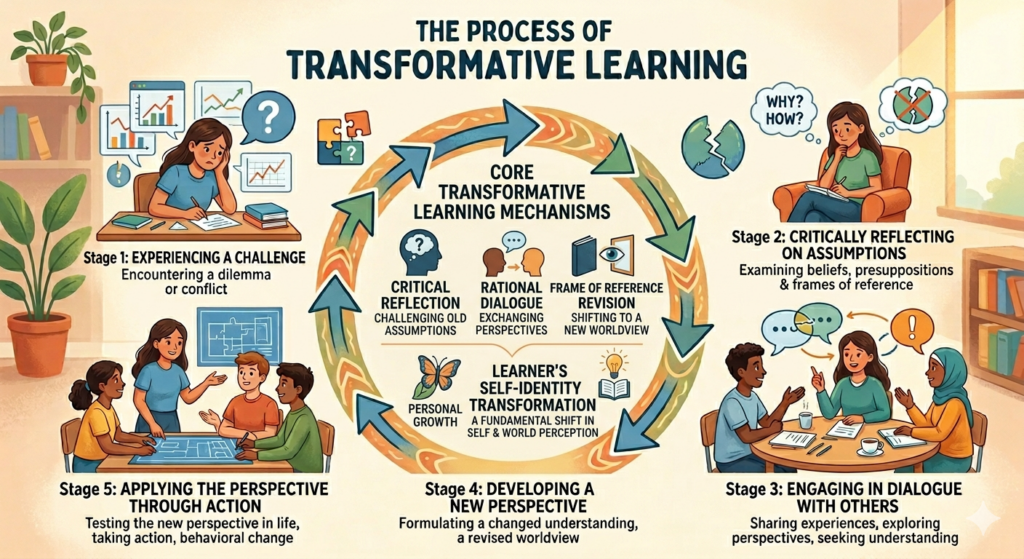
Technology can effectively support transformative learning by providing opportunities for reflection, collaboration, and exposure to diverse viewpoints. Online discussion boards, blogs, digital portfolios, and collaborative platforms such as Microsoft Teams or WordPress allow learners to share experiences and engage in meaningful conversations. These tools encourage learners to think critically about their own assumptions while considering alternative perspectives presented by others.
According to Mezirow (1997), critical reflection and discourse are essential components of transformative learning because they help individuals evaluate their beliefs and make informed decisions. In my own learning design, I would incorporate reflective journals, peer discussions, and case studies that encourage learners to analyze real-world issues from multiple perspectives. Rather than focusing on finding a single correct answer, learners would be encouraged to question ideas, support their reasoning with evidence, and reflect on how their understanding has evolved.
One challenge of transformative learning is that learners may feel uncomfortable questioning long-held beliefs or discussing complex issues with others. To address this, instructors should provide appropriate scaffolding and create an inclusive environment where learners feel respected and supported throughout the learning process. Reflection prompts and instructor feedback can help guide learners without limiting their ability to think independently.
Overall, transformative learning is a valuable approach for technology-mediated education because it encourages critical thinking, self-reflection, and lifelong learning. By combining digital tools with meaningful reflection and dialogue, learners can develop deeper understanding and apply new perspectives to future experiences.
References:
- View of Studying digital metamorphosis in university pedagogy: A systematic review | Open Scholarship of Teaching and Learning. (n.d.). https://osotl.org/osotl/en/article/view/144/231\
- Javed, F. (2024). Transformative Learning Strategies for Effective teaching and Learning in Digitized Higher Education. Jurnal Pendidikan, 25(1), 14–19. https://doi.org/10.33830/jp.v25i1.7330.2024
- Google Gemini. (2026). Diagram of transformative learning cycle with technology.
Hello Hitakshi!
I really enjoyed reading your insights on how technology can effectively support transformative learning. I also really liked the multi-media aspect you added. I feel you could have gone more in depth about how your learning design reflects well with Mezirow’s argument. Overall, I think this reflection was very concise.
Thank you!
Hi Hitakshi!
I enjoyed reading your post. I liked how you explained that technology should support learning rather than just be added for the sake of it. That really stood out to me because I think it’s easy to focus on the technology itself and forget about the learner’s experience.
I could relate to your point because I learn best when technology lets me actively participate, whether it’s through interactive videos, quizzes or discussions.
Thanks for sharing your perspective!