I really enjoyed reading your post! I like how you connected the learning activity to real-world situations and encouraged students to think critically rather than just memorize information. Your ideas were clear, practical, and easy to follow. I also appreciate the way you made the activity engaging and meaningful for learners.
I really enjoyed reading your post! I like how you connected cooperative learning with digital wellness and showed how working together can help students develop healthier technology habits. I also loved the way you included Katrina Kaif—it made the post more fun, engaging, and relatable. Your ideas were clear and easy to follow, and I appreciate your focus on collaboration, as it encourages students to learn from one another while building communication and critical thinking skills.
I really enjoyed reading your post! I like how you explained the importance of engaging learners beyond simply watching a video. Your follow-up activity encourages students to apply what they learned, which makes the learning experience more meaningful. I also appreciate that you considered collaboration and peer feedback, as those can help students develop a deeper understanding of the topic.
I enjoyed reading your post! I really like your idea of using a Digital Habit Audit because it encourages learners to reflect on their own habits instead of just watching a video. I also appreciate that you included accessibility features like captions and transcripts to make the activity more inclusive. Great job creating an engaging and thoughtful learning experience!
We have all been there as digital learners. You click “play” on a required instructional video, lean back in your chair, and within minutes, your mind begins to drift. Maybe you check your phone, or maybe the audio simply morphs into background white noise. This is the trap of passive consumption—a design flaw where the learner’s only job is to let information wash over them.
Recently, I decided to explore a solution to this exact problem by diving into an Interactive Video activity hosted on the eCampusOntario H5P Studio.
What I found was a simple but profound shift in how we experience video-based instruction: the transition from passive viewing to active, intentional engagement.
Breaking the Monologue: What is H5P Interactive Video?
At its core, the H5P Interactive Video tool allows creators to layer an interactive element right on top of standard video content. Instead of treating a video like a one-way monologue, H5P transforms it into an active dialogue.
As I moved through the module on the eCampusOntario platform, the traditional timeline was punctuated by predetermined formative checkpoints. The video would automatically pause, and an overlay would appear directly over the video player—requiring me to solve a problem, answer a multiple-choice question, drag text into the correct place, or reflect on a prompt before the content would resume.
The UDL Connection: Designing for Learner Variability
When we analyze the H5P Interactive Video tool through an educational framework, its true value becomes clear: it is a highly practical engine for Universal Design for Learning (UDL). Rather than assuming a single “average” learner who possesses perfect auditory focus, the tool embraces learner variability across all three core UDL pillars:
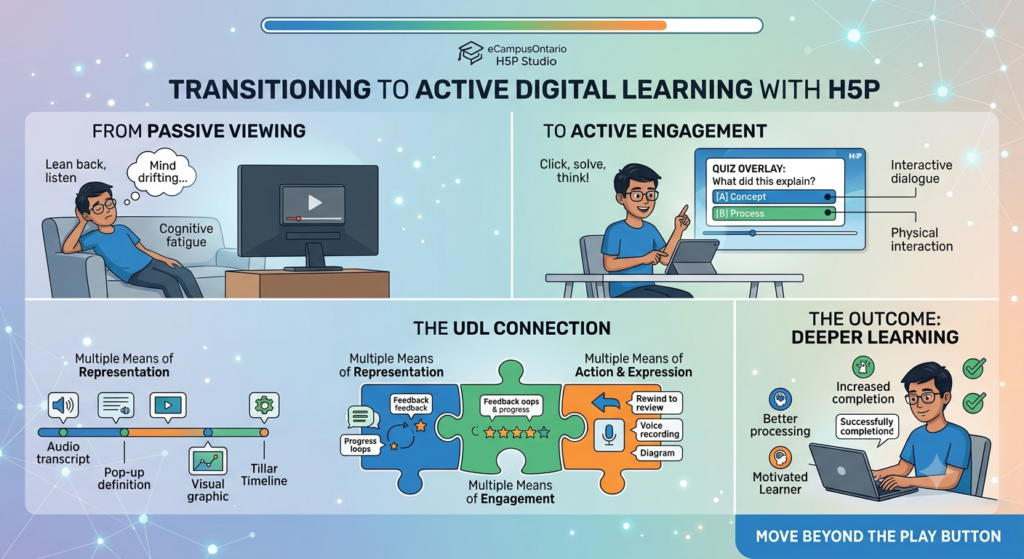
How H5P interactive video transforms passive digital learning into active engagement
1. Multiple Means of Engagement (The “Why” of Learning)
Sustaining effort and persistent focus is incredibly challenging in isolated digital spaces. H5P targets this by breaking up a lengthy video into bite-sized, interactive milestones. Because learners are continually prompted to interact, they remain active agents in the learning process. Furthermore, the tool supports learner autonomy; students receive immediate, private feedback on embedded quiz questions, removing the high-stakes anxiety of traditional exams and encouraging a safe space for trial and error.
2. Multiple Means of Representation (The “What” of Learning)
A standard video forces information through a single primary channel—usually auditory mixed with some static visuals. H5P allows creators to offer alternative pathways for processing that information. By embedding interactive text summaries, pop-up definitions, or links to external resources at critical moments in the timeline, it ensures that learners can access multi-modal representations of the same concept. If a student misses an audio cue, the visual interaction layer steps in to fill the gap.
3. Multiple Means of Action & Expression (The “How” of Learning)
UDL challenges educators to provide flexible options for how students interact with content and navigate their learning environment. H5P’s adaptive behavioral settings do exactly this. For instance, if a learner answers a mid-video checkpoint incorrectly, the system can be configured to automatically rewind the video to the exact moment the topic was explained. This gives the student immediate, self-paced control over their remediation path, ensuring they navigate the content according to their personal processing speed.
The Psychology of the “Micro-Checkpoint”
Why does this minor change fundamentally alter the learning experience? It comes down to cognitive load and processing.
Interrupted Passivity: By forcing a physical interaction (clicking, dragging, thinking), the tool prevents the “zoning out” phenomenon. You cannot passively reach the end of the video; you must actively work your way there. This shift from simple viewing to mechanical engagement moves students out of passive processing and into an active, constructive cognitive state (PLOS ONE, 2023).
Immediate Feedback Loops: In traditional video learning, you watch a 15-minute clip and take a quiz at the very end. If you misunderstood a concept in minute three, you carry that misunderstanding through the entire video. H5P fixes this by embedding the question exactly when the concept is fresh, letting you know instantly if you’ve grasped the material.
The Takeaway
Exploring the eCampusOntario H5P Studio reminded me that effective digital instruction isn’t just about delivering high-quality content; it’s about engineering an active environment for the person on the other side of the screen. Robust empirical data supports this shift, confirming through large-scale meta-analyses that enhanced interactive videos with embedded tasks yield significantly higher student retention and deeper comprehension than standard, linear video playback (Ploetzner et al., 2022).
By utilizing interactive layers, we stop treating students as passive vessels to be filled with information and start treating them as active participants in their own cognitive journey. If we want deeper digital learning, it’s time to move beyond the play button.
Reference:
Ploetzner, R. (2022). The effectiveness of enhanced interaction features in educational videos: a meta-analysis. Interactive Learning Environments, 1–16. https://doi.org/10.1080/10494820.2022.2123002
Jacob, T., & Centofanti, S. (2023). Effectiveness of H5P in improving student learning outcomes in an online tertiary education setting. Journal of Computing in Higher Education, 36(2), 469–485. https://doi.org/10.1007/s12528-023-09361-6
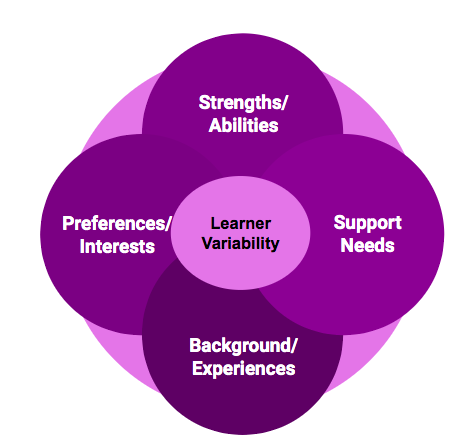
A recent learning experience that stood out to me was an online university course that relied heavily on long recorded lectures and timed quizzes. The course seemed to assume that all students learn best by listening to information for extended periods and then demonstrating understanding under strict time limits. This design reflected the idea of an “average learner,” where everyone is expected to process information in the same way and at the same pace. However, in reality, learners vary greatly in their attention span, language background, prior knowledge, technology access, and learning preferences.
If I were redesigning this course using Universal Design for Learning (UDL) principles, I would first provide multiple means of representation. Instead of only offering recorded lectures, I would include written summaries, transcripts, visual diagrams, and short concept videos so students could choose the format that helps them learn most effectively. The CAST UDL Guidelines explain that learners differ in how they perceive and comprehend information, so providing options increases accessibility and understanding (CAST, 2024).
Second, I would offer multiple means of engagement by breaking longer lectures into shorter modules with interactive activities, reflection questions, and opportunities for peer discussion. The UDL On Campus resource highlights that engagement can be supported by offering choice, relevance, and collaboration (CAST, 2024).
Finally, I would redesign assessments to provide multiple means of action and expression. Rather than relying solely on timed quizzes, students could demonstrate learning through short written responses, presentations, discussions, or project-based tasks. This would reduce barriers for learners who experience test anxiety, require more processing time, or express their understanding better through alternative formats (CAST, 2024).
What I have learned from this experience is that educational design should not begin with the assumption that there is a single “normal” learner. Instead, variability should be treated as the starting point. When courses are designed with flexibility, choice, and accessibility in mind, more students can participate meaningfully and succeed without needing special accommodations later. Designing for variability benefits everyone, not just learners who are struggling.
Transformative learning is an educational approach that encourages learners to critically examine their beliefs, assumptions, and experiences in order to develop new perspectives. According to Mezirow (1991), learning becomes transformative when individuals reflect on their existing views and engage in discussions that challenge their way of thinking. Rather than simply acquiring knowledge, learners actively construct meaning and apply their new understanding to future situations.
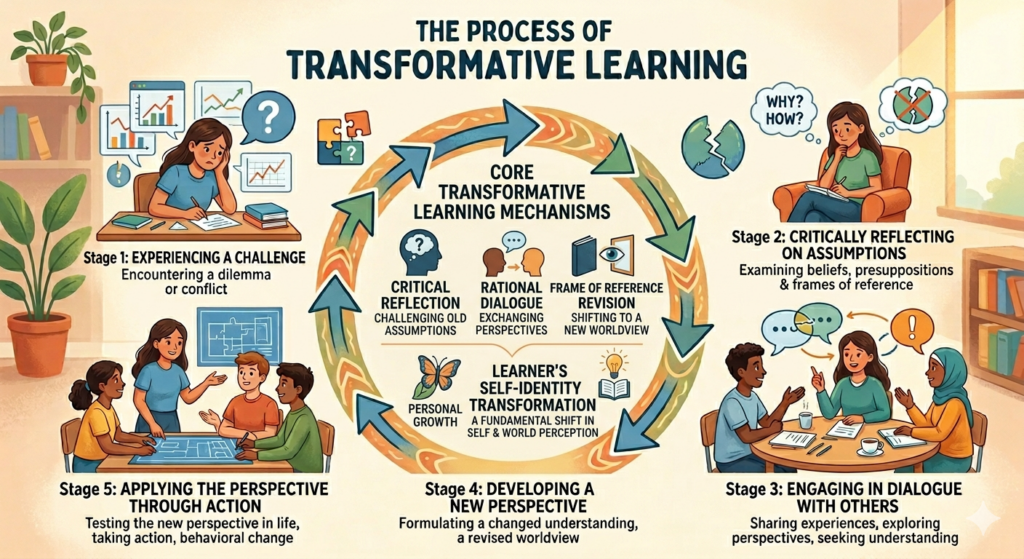
A simple cycle illustrating the process of transformative learning: experiencing a challenge, critically reflecting on assumptions, engaging in dialogue with others, developing a new perspective, and applying that perspective through action.
Technology can effectively support transformative learning by providing opportunities for reflection, collaboration, and exposure to diverse viewpoints. Online discussion boards, blogs, digital portfolios, and collaborative platforms such as Microsoft Teams or WordPress allow learners to share experiences and engage in meaningful conversations. These tools encourage learners to think critically about their own assumptions while considering alternative perspectives presented by others.
According to Mezirow (1997), critical reflection and discourse are essential components of transformative learning because they help individuals evaluate their beliefs and make informed decisions. In my own learning design, I would incorporate reflective journals, peer discussions, and case studies that encourage learners to analyze real-world issues from multiple perspectives. Rather than focusing on finding a single correct answer, learners would be encouraged to question ideas, support their reasoning with evidence, and reflect on how their understanding has evolved.
One challenge of transformative learning is that learners may feel uncomfortable questioning long-held beliefs or discussing complex issues with others. To address this, instructors should provide appropriate scaffolding and create an inclusive environment where learners feel respected and supported throughout the learning process. Reflection prompts and instructor feedback can help guide learners without limiting their ability to think independently.
Overall, transformative learning is a valuable approach for technology-mediated education because it encourages critical thinking, self-reflection, and lifelong learning. By combining digital tools with meaningful reflection and dialogue, learners can develop deeper understanding and apply new perspectives to future experiences.
Javed, F. (2024). Transformative Learning Strategies for Effective teaching and Learning in Digitized Higher Education. Jurnal Pendidikan, 25(1), 14–19. https://doi.org/10.33830/jp.v25i1.7330.2024
Google Gemini. (2026). Diagram of transformative learning cycle with technology.
Starting university was a major transition for me. One learning challenge I faced was managing multiple assignments while keeping up with heavy readings and class expectations. In high school, I was more dependent on teacher guidance, so adapting to independent learning was difficult at first. I often felt overwhelmed and struggled with procrastination.
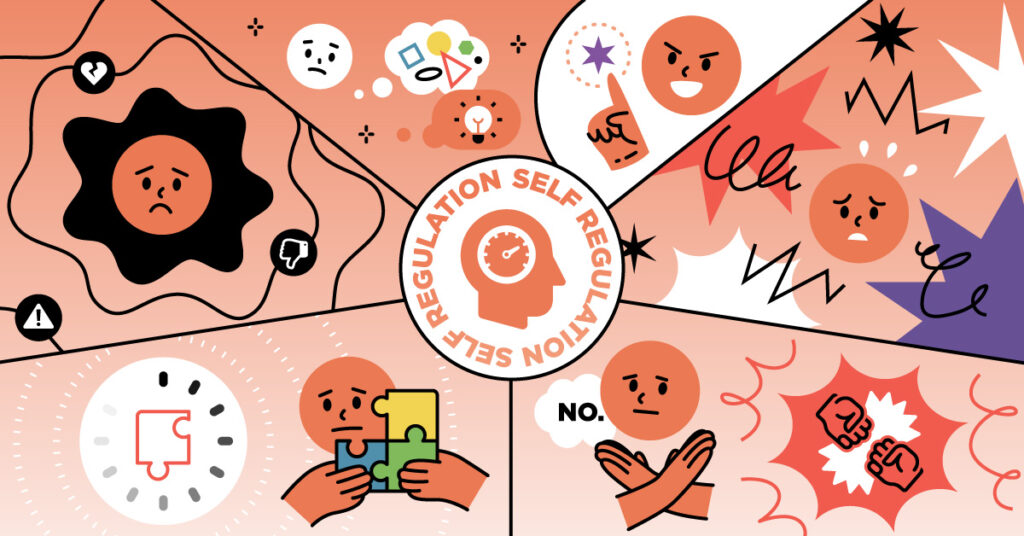
One course concept that helped me understand this experience was self-regulation. Self-regulation involves managing time, setting goals, and monitoring progress. I realized that my difficulty was not a lack of ability, but a need for stronger learning strategies. According to Verywell Mind’s article on self-regulation, self-regulation helps learners stay focused and motivated when facing challenges.
To improve, I started creating weekly schedules and breaking assignments into smaller tasks. I also used active learning techniques such as rewriting notes in my own words and reviewing material regularly instead of cramming. Another important concept I learned was having a growth mindset, which means believing that skills can improve through effort and practice. This helped me become more confident and less afraid of making mistakes.
Over time, these strategies improved both my academic performance and confidence. This experience taught me that learning challenges are a normal part of personal growth. With patience, reflection, and effective strategies, challenges can become opportunities to develop resilience and independence.
References
Zimmerman, B. J. (2002). Becoming a Self-Regulated Learner: An Overview. Theory Into Practice, 41(2), 64–70. https://doi.org/10.1207/s15430421tip4102_2
Cuncic, A. (2026, January 14). How to Develop and Practice Self-Regulation. Very Well Mind. Retrieved May 25, 2026, from https://www.verywellmind.com/how-you-can-practice-self-regulation-4163536